


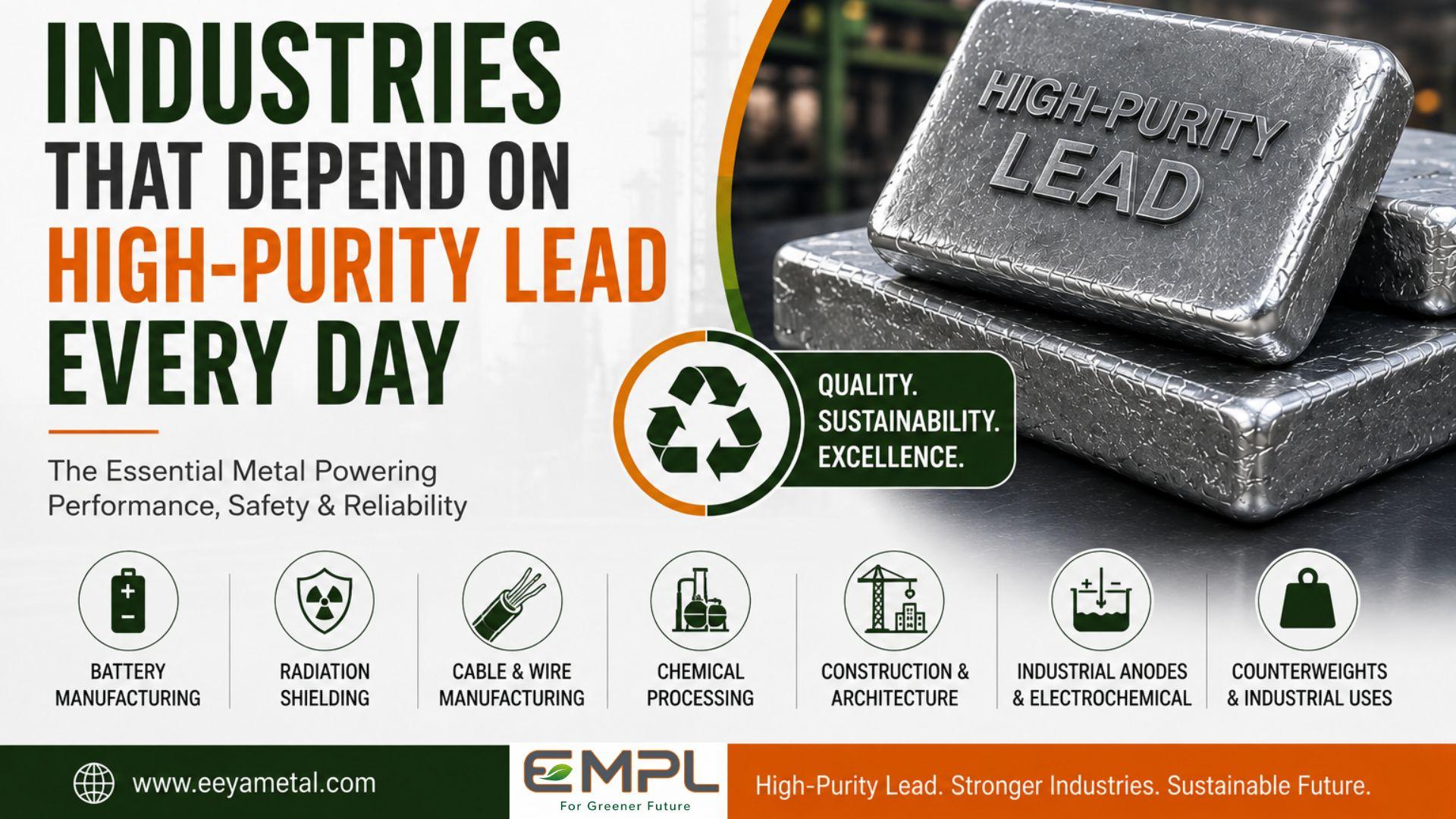
High-purity lead is a critical industrial material used across sectors where material consistency, corrosion resistance, density, electrical performance, and controlled chemical composition matter. From battery manufacturing to radiation shielding and cable production, manufacturers rely on a dependable lead supplier to ensure that the raw material meets their technical and production requirements.
For industries operating at scale, choosing the right lead manufacturer is not simply about purchasing metal. It is about securing consistent quality, reliable supply, appropriate grades, and material that performs predictably in the final application.
In this article, we explore the major industries that depend on high-purity lead and lead alloys and why material quality matters.
What Is High-Purity Lead?
High-purity lead is refined lead containing a very high percentage of lead (Pb), with tightly controlled levels of impurities and, where required, specific alloying elements.
Commercial industrial lead is commonly supplied in forms such as lead ingots, sheets, blocks, and specialized alloys. Depending on the application, manufacturers may require pure lead or engineered lead alloys containing elements such as antimony, calcium, tin, silver, or other controlled additions. Different alloy compositions provide different mechanical, corrosion, casting, or electrical characteristics.
For manufacturers, the important factor is not simply the percentage of lead. Consistency from batch to batch is equally important.
A reliable lead supplier in India should therefore be able to provide:
- Consistent chemical composition
- Controlled impurity levels
- Application-specific grades
- Reliable batch quality
- Proper documentation and traceability
- Consistent supply capacity
- Suitable packaging and delivery
1. Battery Manufacturing
The battery industry is one of the most important users of lead and lead alloys.
Lead-acid batteries use lead-based materials in components such as grids, posts, and connectors. Different battery technologies require different lead compositions, including pure lead, lead-antimony and lead-calcium-tin alloys.
These materials are used across:
- Automotive batteries
- Industrial batteries
- Inverter batteries
- Backup power systems
- Telecommunications batteries
- Stationary energy-storage systems
- Motive-power batteries
The exact alloy composition can influence properties such as strength, corrosion behaviour, grid growth, and suitability for different battery designs.
This makes lead alloy manufacturers particularly important to battery manufacturers that require material tailored to their production specifications.
Why purity matters
In battery manufacturing, uncontrolled impurities or inconsistent alloy chemistry can affect processing and product performance. Therefore, manufacturers often work with a specialized lead manufacturer capable of maintaining controlled chemistry across production batches.
Also Read: How Recycled Metals Reduce Manufacturing Costs
2. Radiation Shielding
Another major application of high-purity lead is radiation protection.
Lead's high density makes it effective for attenuating X-rays and gamma radiation. Consequently, lead is used in radiation-shielding applications in healthcare and industrial environments.
Applications include:
- X-ray rooms
- Diagnostic imaging facilities
- Medical equipment
- Nuclear facilities
- Industrial radiography
- Laboratory environments
- Radiation-shielding barriers
In these applications, material uniformity and appropriate thickness are important considerations.
A dependable high-purity lead supplier can therefore play an important role in supplying the material required for specialized shielding products.
3. Cable & Wire Manufacturing
Lead and lead alloys have historically been used for protective cable sheathing.
Lead sheathing can help protect cables from environmental conditions, particularly moisture and corrosive environments. Specific lead alloys are designed to provide improved mechanical characteristics and resistance to fatigue cracking.
Lead-based materials can be used in:
- Power cables
- Communication cables
- Specialty industrial cables
- Underground cable systems
- Marine applications
For cable manufacturers, the alloy composition must be appropriate for the intended operating environment and manufacturing process.
This is another area where sourcing from an experienced lead alloy supplier can make a significant difference.
4. Chemical Processing Industry
Lead's corrosion resistance makes it useful in certain demanding chemical environments.
Lead and lead alloys have been used for:
- Chemical plant linings
- Tanks
- Pipes and tubes
- Acid-handling equipment
- Industrial process components
- Corrosion-resistant linings
Lead-lined equipment can be particularly relevant where materials are exposed to aggressive chemical environments.
For these applications, manufacturers need to select a material based on the chemical environment, operating conditions, and required service life.
That makes lead quality and alloy selection important considerations during procurement.
5. Construction & Architectural Applications
Lead has also been used in specialized construction applications because of its density, malleability, and corrosion resistance.
Depending on regional regulations and application requirements, lead materials can be used for:
- Roofing applications
- Flashing
- Waterproofing details
- Acoustic applications
- Radiation-shielding construction
- Specialized building components
Lead sheets and lead-containing materials can be selected where their specific physical properties provide an advantage.
For construction-material manufacturers and contractors, sourcing consistent material from an established lead supplier can help maintain product quality and processing consistency.
6. Industrial Anodes & Electrowinning
Lead alloys are also used in specialized electrochemical applications.
Lead-based anodes can be used in electrowinning and other industrial processes, with alloying elements such as calcium, tin or silver selected to achieve application-specific properties.
These materials are relevant to industries involved in:
- Metal recovery
- Electrochemical processing
- Mining
- Refining
- Industrial plating
- Hydrometallurgical processes
Because anodes operate in demanding chemical and electrical environments, their composition and performance characteristics are particularly important.
7. Soldering & Specialized Metal Applications
Lead-tin and other lead-based alloys have traditionally been used in soldering and joining applications.
Lead alloys can also be engineered for specialized uses where controlled melting behaviour, corrosion resistance, or mechanical characteristics are required.
Depending on the application and applicable regulations, lead-based materials may be found in:
- Industrial soldering
- Specialized joining applications
- Certain electronic applications
- Foundry applications
- Specialized coatings
For these applications, precise alloy chemistry becomes a key purchasing consideration.
Also Read: Why Recycled Metals Are the Future of Manufacturing
8. Counterweights, Ballast & Industrial Components
The high density of lead makes it useful in applications where significant weight is required within a relatively compact volume.
Lead and lead alloys can therefore be used for:
- Counterweights
- Ballast
- Vibration-damping applications
- Specialized cast components
- Industrial weights
Lead's combination of density and ease of forming makes it suitable for certain engineered applications where alternative materials may require greater volume.
Why Industries Need Reliable Lead Suppliers
Across all these industries, one common requirement remains: consistency.
A manufacturer may have an established production process designed around a particular grade of lead or lead alloy. If the material composition changes significantly from one batch to another, it can affect processing, casting, forming, or final-product performance.
This is why businesses should evaluate a lead supplier based on more than price.
Key factors include:
1. Purity & Chemical Composition
The supplier should be able to consistently meet the required material specifications.
2. Batch-to-Batch Consistency
Stable chemistry helps manufacturers maintain predictable production.
3. Quality Testing
Laboratory testing and appropriate quality-control procedures provide greater confidence in the supplied material.
4. Product Availability
Industrial production requires a dependable supply chain, particularly for high-volume manufacturing.
5. Technical Understanding
A capable supplier should understand the difference between pure lead and application-specific lead alloys.
6. Documentation & Traceability
Proper documentation can help manufacturers maintain procurement and quality records.
7. Custom Alloy Requirements
Certain applications require controlled additions of elements such as antimony, calcium, tin or silver. An experienced lead alloy manufacturer can support these requirements.
Recycled Lead: Supporting a More Circular Industry
Lead is also particularly relevant to the circular economy because it can be recovered and recycled into useful industrial material.
Recycling can transform recovered lead-bearing materials into refined lead and lead alloys that can re-enter industrial supply chains.
This creates a more circular material flow:
Used Lead-Bearing Material → Collection → Recycling → Refining → High-Purity Lead → Industrial Applications
Responsible recycling can help recover valuable material while reducing the need for virgin raw-material extraction.
For manufacturers, the key is ensuring that recycled or secondary lead undergoes appropriate refining and quality control so that the resulting material meets the required specifications.
How to Choose the Right Lead Manufacturer in India
If your business regularly purchases lead or lead alloys, selecting the right lead manufacturer in India can directly influence procurement reliability and production efficiency.
Before selecting a supplier, consider:
✔ Product Range
Does the supplier offer the specific lead grade or alloy required for your application?
✔ Purity
Are purity levels clearly defined and consistently maintained?
✔ Quality Control
Does the manufacturer have appropriate testing and quality-control processes?
✔ Production Capacity
Can the supplier support your current and future volume requirements?
✔ Consistency
Can they maintain consistent material quality across batches?
✔ Supply Reliability
Can they meet your delivery schedules consistently?
✔ Custom Requirements
Can they manufacture or supply customized lead alloys when required?
✔ Sustainability
Does the company follow responsible recycling and environmentally conscious production practices?
A supplier that can address these areas becomes more than a material vendor—it becomes a long-term industrial supply partner.
The Importance of High-Purity Lead in Modern Manufacturing
From energy storage and radiation protection to cables, chemical processing and specialized industrial applications, lead continues to serve important technical functions across multiple industries.
However, modern manufacturers are increasingly focused on more than simply obtaining raw materials. They require:
Quality + Consistency + Reliability + Traceability + Sustainability
This is why the role of a dependable lead supplier has become increasingly important.
For industries where material chemistry directly affects manufacturing performance, working with an experienced lead manufacturer can help reduce quality variations, improve procurement reliability and support consistent production.
Also Read: What is Non-Ferrous Metal Recycling? Process, Benefits & Guide | EEYA Metal
Why EMPL?
EEYA Metal & Alloys Pvt. Ltd. (EMPL) focuses on supplying high-quality lead and lead alloys for industrial applications, with an emphasis on quality, responsible recycling, manufacturing consistency and reliable supply.
By combining recycling, refining, quality control and manufacturing capabilities, EMPL aims to support industries that depend on dependable lead-based materials.
For manufacturers looking for a lead supplier in India, the focus should always be on finding the right balance of material quality, consistency, technical capability and supply reliability.
The right material is not just a raw material—it is the foundation of reliable manufacturing.


