


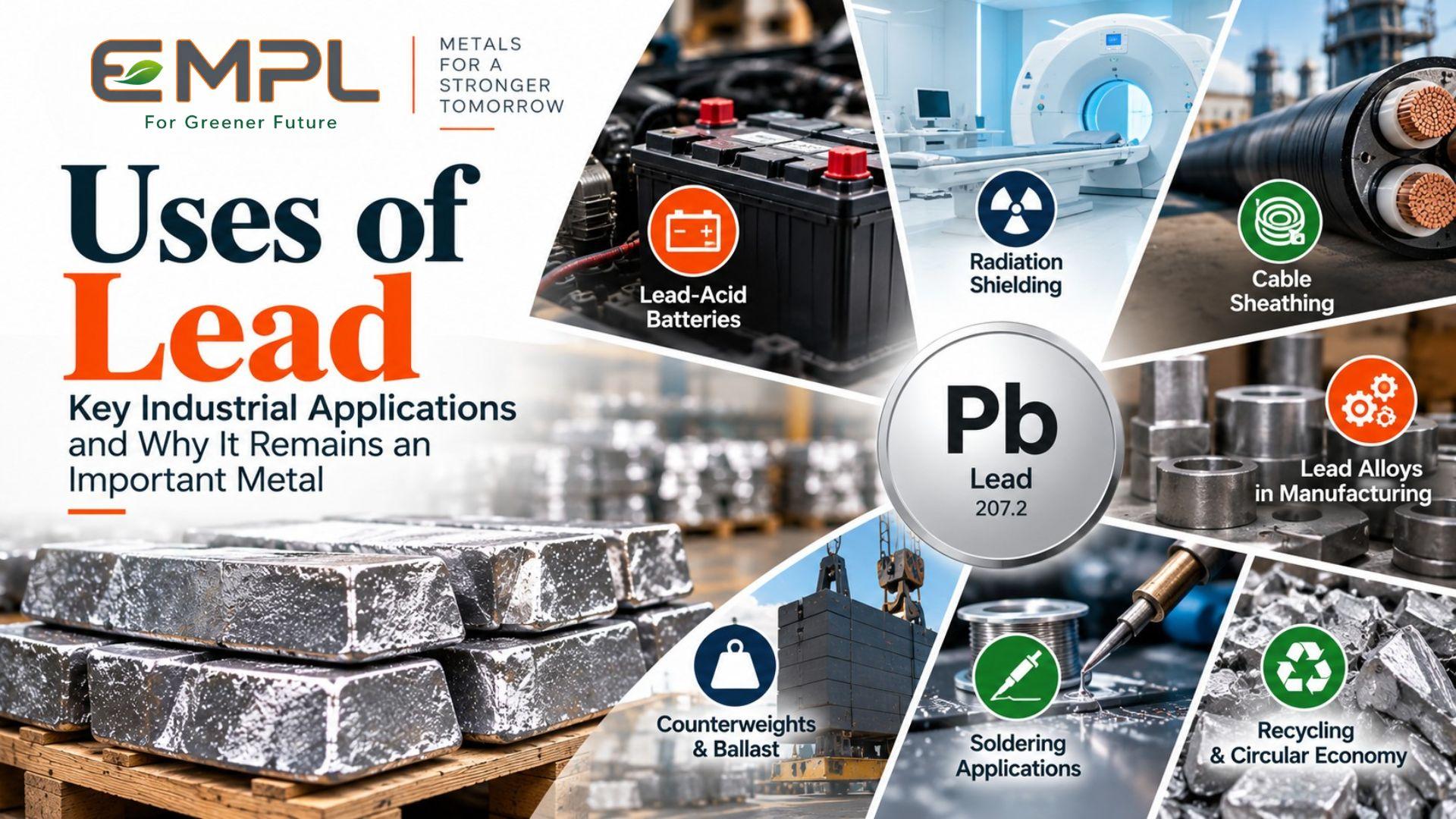
Uses of Lead: Key Industrial Applications and Why It Remains an Important Metal
Lead is an important industrial metal with applications across energy storage, manufacturing, infrastructure, radiation protection, and specialised engineering. Its distinctive physical and chemical properties make it suitable for applications where material density, formability, corrosion resistance in specific environments, and electrochemical performance are important.
Although lead is often associated with batteries, its industrial applications extend well beyond energy storage. Understanding these applications helps manufacturers, procurement professionals, and industrial buyers make informed decisions about material selection and sourcing.
For businesses looking for a reliable lead metal supplier or lead supplier in India, understanding the intended application is an essential first step towards selecting the appropriate material grade, purity, and form.
In this article, we explore the major uses of lead, the properties that support these applications, and the factors businesses should consider when sourcing lead for industrial requirements.
1. Lead-Acid Batteries: The Largest Application of Lead
One of the most important uses of lead is in lead-acid batteries. These batteries remain widely used in automotive, industrial, and backup-power applications because of their established technology, dependable starting performance, and ability to provide standby electrical power.
Lead-acid batteries are used in:
-
Automotive starting, lighting, and ignition systems
-
Uninterruptible power supply (UPS) systems
-
Telecommunications backup power
-
Industrial equipment and material-handling vehicles
-
Emergency power systems
-
Selected renewable-energy storage applications
Lead plays a central role in the electrochemical reactions that allow these batteries to store and deliver electrical energy.
Why Is Lead Used in Batteries?
Lead and lead-based materials offer useful electrochemical characteristics and can be manufactured into battery components with application-specific designs.
Lead alloys may also be used in battery grids and other components. Their composition is selected according to the design, manufacturing process, and performance requirements of the battery.
For battery manufacturers, material consistency is important. Chemical composition, impurity levels, and other specifications must be appropriate for the intended battery design.
This makes the selection of a suitable lead alloy supplier an important consideration for businesses that require repeat industrial orders.
2. Radiation Shielding in Medical and Industrial Applications
Lead is widely recognised for its use in radiation shielding because of its high density and its ability to attenuate X-rays and gamma radiation.
Depending on the design and applicable requirements, lead or lead-containing materials may be incorporated into:
-
Medical imaging rooms
-
X-ray equipment shielding
-
Radiation-protection barriers
-
Industrial radiography facilities
-
Certain specialised research environments
Why Is Lead Used for Radiation Protection?
Lead's high density makes it effective at reducing the intensity of certain forms of penetrating radiation when used in appropriately designed shielding systems.
However, the required shielding depends on factors such as radiation energy, exposure conditions, material thickness, and the design of the installation. Lead should not be treated as a universal shielding solution for every type of radiation.
For industrial buyers, material selection should follow the relevant engineering specifications, radiation-protection requirements, and applicable regulations.
Also Read: Lead Manufacturers in India: Quality, Capacity & Supply Reliability
3. Cable Sheathing and Specialised Infrastructure
Lead has historically been used as a protective sheath around certain electrical and communication cables.
In suitable cable designs, lead's resistance to moisture and corrosion in specific environments can help protect the cable's internal components. Specialised installations, including certain underground and subsea cable systems, have used lead sheathing where the design requirements justify it.
The choice of cable materials depends on operating conditions, installation requirements, mechanical stresses, and applicable standards. Lead is not necessary or preferred for every modern cable application, as alternative materials are available.
For manufacturers working with specialised cable systems, the important consideration is whether the selected material meets the required environmental, mechanical, and performance specifications.
4. Lead Alloys in Industrial Manufacturing
Pure lead and lead alloys serve different purposes. While lead provides the base material in many applications, adding controlled quantities of other elements can modify its properties.
Depending on the formulation, lead alloys may incorporate elements such as antimony, tin, or calcium.
These additions can influence characteristics such as hardness, strength, casting behaviour, and corrosion performance under particular operating conditions.
Common Applications of Lead Alloys
Lead alloys are used in selected applications involving:
-
Lead-acid battery components
-
Specialised cast components
-
Certain bearing and engineering materials
-
Selected industrial products requiring defined lead-alloy properties
The suitability of a particular alloy depends on its composition and intended use. A formulation appropriate for one application may not be suitable for another.
This is why industrial buyers should clearly define the required grade, composition range, and acceptance criteria before purchasing lead alloys.
5. Counterweights, Ballast, and High-Density Applications
Lead's high density makes it useful in applications where substantial weight is needed within a relatively compact space.
Depending on the design and applicable restrictions, lead may be used in selected counterweights, ballast systems, and specialised weighting applications.
Examples can include certain industrial balancing systems, specialised equipment, and applications where space constraints make a dense material useful.
The final material selection depends on engineering requirements, containment, handling, and environmental considerations. Lead is not suitable for every weighting application, particularly where exposure risks or restrictions make alternative materials preferable.
Also Read: Top Industrial Uses of Lead, Tin, and Antimony – Complete Guide
6. Soldering and Specialised Joining Applications
Lead has historically been used in solder alloys for joining metal components in electrical, electronic, and other specialised applications.
Traditional lead-tin solders have particular melting and processing characteristics that made them useful in many joining processes.
However, the use of lead-containing solder is restricted or prohibited in various products and markets. Many modern electronic and consumer applications use lead-free alternatives.
Before specifying a solder alloy, manufacturers should verify the applicable product regulations, customer requirements, and technical standards.
The appropriate solder composition depends on the joining materials, operating temperature, reliability requirements, and manufacturing process.
7. Chemical and Corrosion-Related Industrial Applications
Lead's resistance to certain chemical environments has supported its use in selected specialised applications, including certain linings and protective components.
Its suitability depends heavily on the specific chemical, temperature, concentration, and operating conditions. Lead is not resistant to every corrosive substance, and material compatibility must be assessed carefully.
Industrial applications involving lead must also account for worker safety, environmental protection, maintenance, and end-of-life handling.
Where alternative materials provide the required performance with lower health or environmental risks, they may be preferable.
8. Lead Recycling and the Circular Material Economy
Lead is notable for its role in established recycling systems, particularly those associated with lead-acid batteries.
Recovered lead can be processed and refined for reuse in suitable applications, provided the material meets the required quality specifications and applicable regulatory requirements.
A responsible recycling system involves more than recovering metal. It also requires suitable collection, controlled processing, pollution prevention, worker protection, and appropriate management of residues and waste.
Why Is Quality Important in Recycled Lead?
Recycled material may require refining and composition control before it is suitable for a particular end use.
Industrial buyers should evaluate recycled lead according to the same application-specific requirements that apply to other material sources. Relevant factors include purity, impurity limits, alloy composition, and supporting documentation.
Recycling can help recover valuable material and reduce the need for primary raw-material extraction. However, poorly controlled lead recycling can cause serious contamination and human exposure. Responsible operations and effective environmental controls are essential.
9. How to Choose the Right Lead Grade for Your Application
Different lead applications require different material characteristics. Selecting the correct grade is therefore an important part of industrial procurement.
Before placing an order, buyers should consider the following factors.
Purity requirements: Confirm the required lead purity and permitted impurity levels for the intended use.
Chemical composition: For lead alloys, verify the required concentrations of alloying elements.
Material form: Determine whether the application requires ingots, sheets, specialised cast forms, or another product form.
Technical specifications: Check relevant engineering standards, customer specifications, and application requirements.
Testing and documentation: Establish what material test reports or certificates are needed.
Supplier capability: Assess whether the supplier can provide the specified material and communicate its requirements clearly.
Safety and regulatory compliance: Confirm the applicable requirements for handling, storage, transport, use, and disposal.
For recurring industrial requirements, buyers should also consider specification management, batch consistency, delivery coordination, and communication when evaluating a supplier.
10. What to Look for in a Lead Supplier in India
Choosing a lead supplier in India involves more than comparing quotations. The right supplier should be able to understand the material specification, clarify the product being offered, and align the supply arrangement with the buyer's requirements.
Useful evaluation criteria include:
-
Clear material and alloy specifications
-
Defined purity and composition requirements
-
Appropriate quality documentation
-
Consistency across repeat orders
-
Clear communication about availability and delivery
-
Suitable packaging and shipment arrangements
-
Compliance with relevant safety and environmental requirements
Businesses searching for the best lead supplier should assess suppliers against these practical criteria rather than relying on broad marketing claims alone.
The best choice will depend on the application, technical requirements, order quantities, commercial terms, and the level of documentation and support required.
11. Lead Safety and Responsible Industrial Use
While lead has important industrial applications, it is also a toxic metal that can harm human health and contaminate the environment.
Exposure can occur through inhalation of lead-containing dust or fumes and through ingestion of contaminated dust, soil, water, or other materials. Occupational exposure is a particular concern in activities involving lead processing, manufacturing, and recycling.
The World Health Organization notes that lead exposure can affect multiple body systems and is particularly harmful to children and pregnant women. No level of lead exposure is known to be without harmful effects.
Responsible lead use therefore requires appropriate engineering controls, safe work practices, hygiene measures, worker protection, and environmental management. Collection and recycling must also be conducted using suitable controls to prevent contamination.
Industrial buyers should ensure that the materials and processes they specify comply with the applicable safety and environmental requirements.
Conclusion
Lead remains an important industrial material because of its distinctive properties and its role in several established applications. From lead-acid batteries and radiation shielding to selected cable systems, specialised alloys, and high-density components, its uses depend on the specific characteristics required by each application.
However, selecting lead is not simply a matter of choosing the metal itself. The appropriate grade, purity, composition, material form, and quality documentation must match the intended use.
For manufacturers and procurement teams looking for a lead metal supplier or lead supplier in India, clearly defined specifications and responsible material sourcing are essential to making informed purchasing decisions.
At EEYA Metal & Alloys Pvt. Ltd. (EMPL), understanding industrial metal requirements is an important part of the broader conversation around material selection and supply.
Looking for industrial metal supply solutions? Visit www.eeyametal.com to learn more about EEYA Metal & Alloys Pvt. Ltd.


